
A toilet that moves when you sit on it is not being held evenly and securely against a stable floor. Loose mounting hardware is one possibility, but an uneven tile surface, damaged closet flange, inadequate support under the base, softened subfloor, or a toilet that was set incorrectly can produce the same rocking or shifting sensation.
Do not keep testing the movement or tighten the mounting nuts blindly. Repeated rocking can stress the porcelain, flange, drain connection, seal, supply line, and floor. Uneven tightening can crack the toilet. A focused inspection should identify what is moving and why before a repair is chosen.
Stop using the fixture if water appears at the base, sewer odor becomes noticeable, the porcelain is cracked, the movement increases, the floor feels soft, or the tank and supply connection move with the bowl. Keep the area dry and arrange toilet repair in Los Angeles before the condition turns into leakage or floor damage.
A Toilet Should Feel Solid Under Normal Use
The toilet bowl is mounted over a drain opening in the floor. A closet flange connects the fixture to the drain system and provides mounting points that hold the toilet in position. A seal between the toilet outlet and flange keeps wastewater and sewer gas inside the drain path. The floor and subfloor provide the broad, stable surface that supports the weight of the fixture and the person using it.
Those parts have different jobs. The mounting hardware keeps the toilet from shifting, but the porcelain base and floor must carry the load evenly. The bolts are not meant to pull a rocking toilet down against a distorted surface or compensate for damaged support. When the base does not rest evenly, tightening one side can concentrate stress in the porcelain without correcting the underlying gap.
A slight click, a visible shift at the caulk line, or a small side-to-side rock still deserves attention. Movement is evidence that the base, mounting, flange, or floor is not working as a stable assembly.
Loose Mounting Hardware Is Only One Possible Cause
Mounting hardware can loosen over time, especially when the toilet was not fully stable when installed. Repeated use can allow the fixture to move against the hardware, enlarging the motion and placing more force on the flange.
A missing bolt cap, visible corrosion, a nut sitting unusually high, or a base that shifts around one mounting point can make loosened hardware more likely. Those clues do not prove that tightening is safe. The flange below the toilet may be cracked, the mounting slot may be damaged, or the bolt may be pulling through weakened material. A nut can also appear loose because the toilet is resting on an uneven floor.
Do not remove the cap or turn the nut to see whether it helps. Porcelain does not bend like metal. Uneven or excessive force can create a hairline crack that leaks or fails later. A plumber can inspect the mounting while controlling the load on the fixture and determine whether the hardware is the cause or merely a symptom.
Uneven Tile or Flooring Can Leave the Base Unsupported
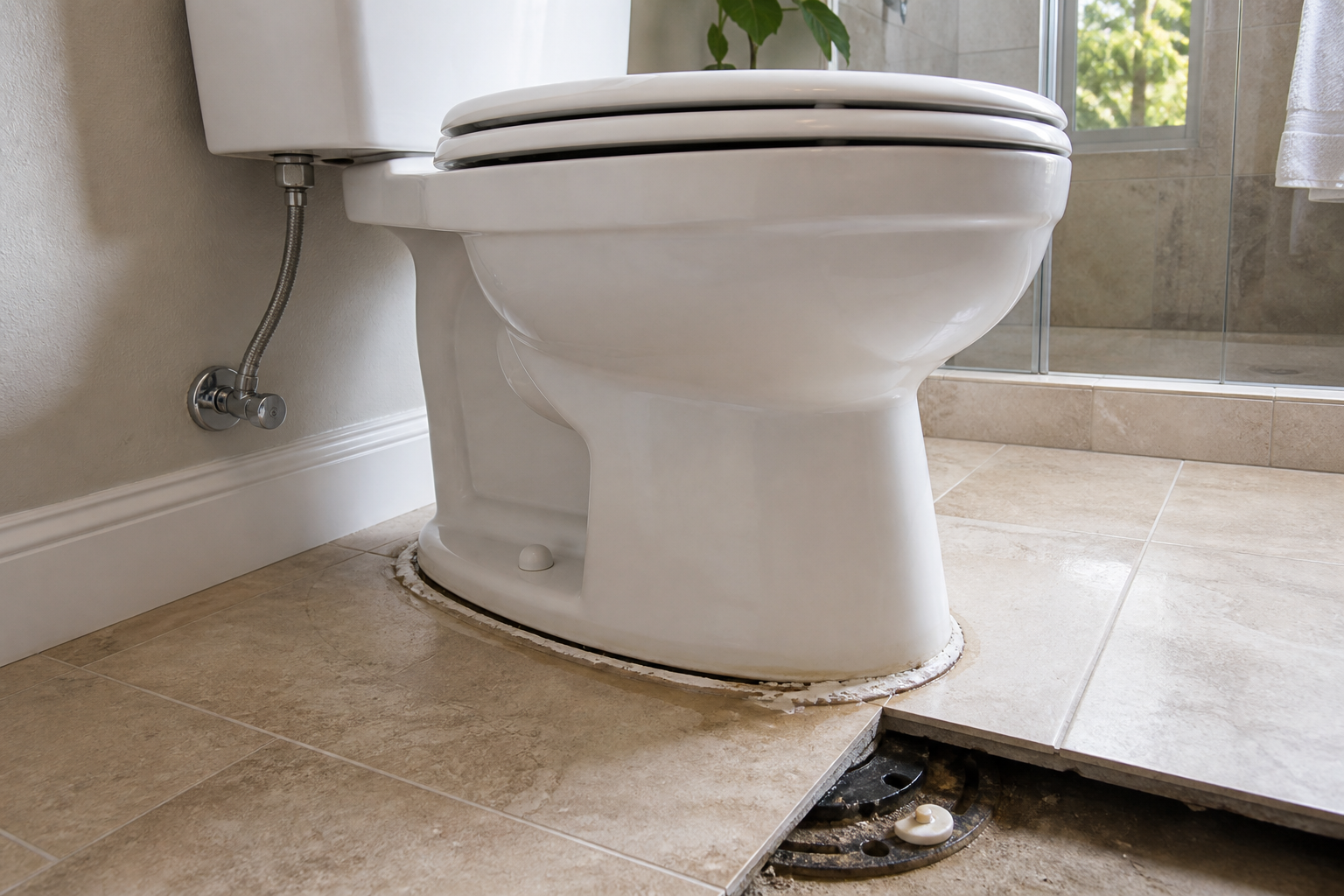
Bathroom floors are not always perfectly flat. A tile edge, deep grout joint, floor slope, lippage between tiles, or a repaired surface can leave one portion of the toilet base unsupported. The fixture may feel solid in one direction and rock in another as weight shifts across the high point.
The old caulk outline can sometimes reveal that the toilet has changed position. A separated line on one side and compressed material on the other may show the direction of movement. A visible gap is useful evidence, but pushing the bowl to measure it can worsen the problem.
Support corrections must be compatible with the toilet, floor, flange height, and seal. Sliding an improvised object under the base can create a hard pressure point, interfere with the drain alignment, or hide continued movement. Adding caulk around an unstable toilet can conceal moisture without restoring support. The base must be stabilized by a repair matched to the actual floor and mounting condition.
A Damaged or Poorly Positioned Flange Can Let the Toilet Shift
The closet flange sits at the drain opening and anchors the toilet. Depending on the installation, it may be plastic, metal, cast iron, or a combination of materials. Age, corrosion, prior repairs, overtightening, floor changes, and repeated movement can crack the flange or damage its mounting slots.
Flange height also matters. New tile installed over an older floor can leave the flange too low relative to the finished surface. A flange that is loose from the subfloor may move with the toilet. An off-center or poorly aligned installation can place uneven force on the mounting points.
These conditions are mostly hidden while the toilet is installed. The movement pattern can suggest a flange problem, but the fixture often must be removed safely before the flange, fasteners, drain opening, and surrounding floor can be evaluated. Replacing mounting hardware alone will not correct a flange that is cracked, unsupported, or at an unsuitable height.
A Soft Floor Can Make the Whole Assembly Move
Water exposure can weaken wood-based subflooring around a toilet. The moisture may come from a failed toilet seal, supply connection, tank leak, nearby tub or shower, condensation, prior overflow, or an older leak that is no longer active. Termite damage or an inadequate previous floor repair can also reduce support.
A soft floor may feel springy underfoot, show staining, develop a depression around the base, or allow tile and grout to crack. The toilet can seem to move even when the mounting hardware remains attached because the material beneath the flange is flexing.
Do not press, probe, or cut the floor to test it. Avoid putting additional weight on a visibly deflecting area. If moisture is suspected beyond the base, professional leak detection can help determine whether an active plumbing source remains before floor repairs begin.
Plumbing repair and floor repair may both be needed. The toilet cannot be reset securely until the flange and surrounding support can hold the expected load. Damaged finished flooring, subfloor, or framing may require a qualified flooring or construction professional after the plumbing source is controlled.
Movement Can Compromise the Toilet Seal
The seal between the toilet outlet and closet flange is designed to stay compressed and aligned. Rocking can disturb that relationship. Water may then escape during flushing, or sewer gas may pass around a compromised seal even when no liquid is visible.
A moving toilet does not prove that the seal has already failed. Likewise, a dry floor does not prove the seal is intact. Small leaks can travel beneath flooring or into the ceiling below rather than appearing around the base. A seal may also leak only during a flush.
Watch for water at the base, darkened grout, staining on a lower ceiling, a persistent sewer-like odor, loose flooring, or moisture returning after the area is dried. Stop using the toilet if any of those signs appear. Avoid adding caulk as a moisture barrier before the source is identified, because it can trap or redirect leaking water.
A Recent Installation or Floor Project Is Important Context
Tell the plumber if the movement began after the toilet was replaced, reset, removed for a drain service, or reinstalled after new flooring. The timing can point toward a seal, flange-height, alignment, support, or mounting issue without proving which one occurred.
A thicker finished floor can change the relationship between the toilet outlet and flange. A prior flange repair may not have been secured to sound material. The fixture may also have been set over debris, old caulk, grout, or an uneven transition that prevented full base contact.
Do not assume the installer only needs to tighten the bolts. The repair should verify the floor surface, flange, seal, and mounting as a system. A stable result matters more than preserving a prior setup that was not supporting the fixture correctly.
Safe Observations to Record Before Service
Useful information can be gathered without dismantling or repeatedly rocking the toilet. From a dry, stable position, note:
- Whether the bowl moves side to side, front to back, or around one corner.
- Whether movement occurs when sitting, standing, or leaning against the tank.
- Whether the tank moves independently or together with the bowl.
- Whether the base has separated from an old caulk line.
- Whether grout, tile, vinyl, or flooring is cracked, stained, swollen, or depressed.
- Whether water, mineral residue, or darkened material appears around the base.
- Whether a sewer-like odor is present before or after flushing.
- Whether the condition began after installation, drain work, a clog, an overflow, or flooring work.
- Whether a supply valve, connector, or wall connection moves when the fixture shifts.
- Whether the room below has new staining or dampness.
Photographs from several angles can preserve the visible condition. A short video taken without touching the fixture can document movement that occurs during ordinary use. Do not sit on the toilet again solely to create a recording.
Keep children and guests from using an unstable fixture. If another bathroom is available, use it until the affected toilet can be inspected.
Do Not Tighten, Shim, or Reseal the Base Blindly
A loose toilet can look like a simple hardware problem, but each quick fix carries risk when the support condition is unknown.
Blind tightening can crack porcelain
Turning one mounting nut farther than the other can twist the base or concentrate force near the bolt opening. A hidden flange defect can also allow the hardware to move without securing the fixture. Stop before applying force to porcelain.
Improvised shims can create pressure points
The correct support depends on the size and location of the gap, the floor surface, and the flange relationship. A hard object placed under one edge can stabilize the toilet temporarily while shifting stress elsewhere or changing the seal compression.
Caulk can hide continued movement or leakage
Sealant around a base is not a structural repair. It does not restore a damaged flange, sound subfloor, or even floor contact. Applying it before inspection can conceal water and make later diagnosis harder.
Replacing only the visible hardware may miss the real failure
New bolts cannot anchor securely to a cracked flange or weakened floor. The fixture must be supported by sound material and aligned with the drain before the mounting can work as intended.
What a Plumber Checks
A focused inspection separates movement at the porcelain base from movement in the flange or floor. The plumber first checks the visible fixture, supply connection, tank attachment, base contact, floor condition, and movement direction without stressing the toilet unnecessarily.
If the cause cannot be confirmed externally, the water supply can be controlled and the fixture removed using a procedure that protects the property and porcelain. The exposed area allows direct inspection of:
- The toilet outlet and underside of the base.
- The old seal and evidence of uneven compression or leakage.
- The closet flange material, height, alignment, mounting slots, and fasteners.
- The condition of the drain opening.
- Moisture, staining, deterioration, or movement in the surrounding floor.
- The contact surface where the toilet base must rest.
The repair should be based on those findings. A sound flange with loose hardware calls for a different response than a broken flange, soft subfloor, uneven tile, damaged toilet base, or incorrectly positioned drain connection.
The Correct Repair Depends on the Support Problem
Possible repair directions include replacing suitable mounting hardware, correcting a compatible flange-height issue, repairing or replacing a damaged flange, securing the flange to sound support, addressing an uneven base contact, installing the appropriate new seal, or resetting the toilet in proper alignment.
If the subfloor is wet or deteriorated, the plumbing source must be controlled and the damaged support evaluated before the toilet is reset. A cracked toilet or damaged base may require fixture replacement. A compromised supply connector or shutoff should be corrected separately rather than pulled into position by the toilet.
After resetting, the plumber should confirm that the fixture remains stable under normal load, the tank and supply connection are secure, flushing and refilling operate normally, the drain connection does not leak, and no sewer odor remains. The base should not depend on excessive bolt tension for stability.
When a Moving Toilet Is Urgent
Stop using the fixture and arrange prompt service when:
- Water appears during or after flushing.
- The floor feels soft, sinks, or visibly moves.
- Porcelain is cracked or makes a new clicking sound.
- The toilet shifts enough to strain the supply line or valve.
- A sewer-like odor persists.
- The movement is increasing quickly.
- Water reaches a wall, ceiling, electrical component, or another room.
- The only available shutoff is corroded, leaking, or unsafe to operate.
Use an emergency plumber in Panorama City and Los Angeles when an active leak is spreading, the floor is becoming unsafe, or a supply connection is releasing water. Keep clear of wet electrical equipment and softened flooring.
Get a Stable, Leak-Free Toilet Base
A moving toilet is a support and mounting problem until an inspection identifies the exact cause. Tightening the visible hardware without checking the flange, floor, seal, and base can damage porcelain or leave a hidden leak unresolved.
MAP Plumbing and Rooter can inspect the fixture movement, remove the toilet when needed, evaluate the flange and seal, check for moisture and floor-support concerns, and explain the narrowest appropriate plumbing repair. Contact MAP Plumbing and Rooter when a toilet rocks, shifts away from its caulk line, leaks at the base, or no longer feels secure in your Los Angeles home.
Frequently Asked Questions
Is it safe to use a toilet that rocks slightly?
Movement is not normal, even when no water is visible. Continued use can stress the porcelain, mounting, flange, seal, supply connection, and floor. Use another fixture if possible and schedule an inspection, especially when the movement is new or increasing.
Does a rocking toilet always need a new wax ring?
No. The seal may be compromised, but movement can also come from loose mounting, an uneven floor, flange damage, poor flange height, or soft subfloor. The support problem must be identified before deciding which parts need replacement.
Can I tighten the bolts at the base myself?
Blind tightening can crack porcelain or pull against a damaged flange. It may also make the toilet seem stable temporarily while an unsupported base or weak floor remains. A plumber should verify the mounting and support before applying force.
Why does the toilet move only when I sit on one side?
One-sided movement can occur when the floor contact is uneven, one mounting point is loose or damaged, the flange is not secure, or the floor flexes in that area. The direction is useful evidence but does not identify the failed part by itself.
Can caulk stop a toilet from rocking?
Caulk is not a substitute for sound floor support, a secure flange, correct mounting, and an intact seal. Applying it around an unstable base can hide moisture and continued movement rather than correct the cause.
What if the toilet moves but the floor stays dry?
A dry visible floor does not rule out seal damage or moisture beneath the surface. The movement still needs correction because it can create leakage later. Watch for odor, staining below the bathroom, cracked grout, or softened flooring and report those clues.