
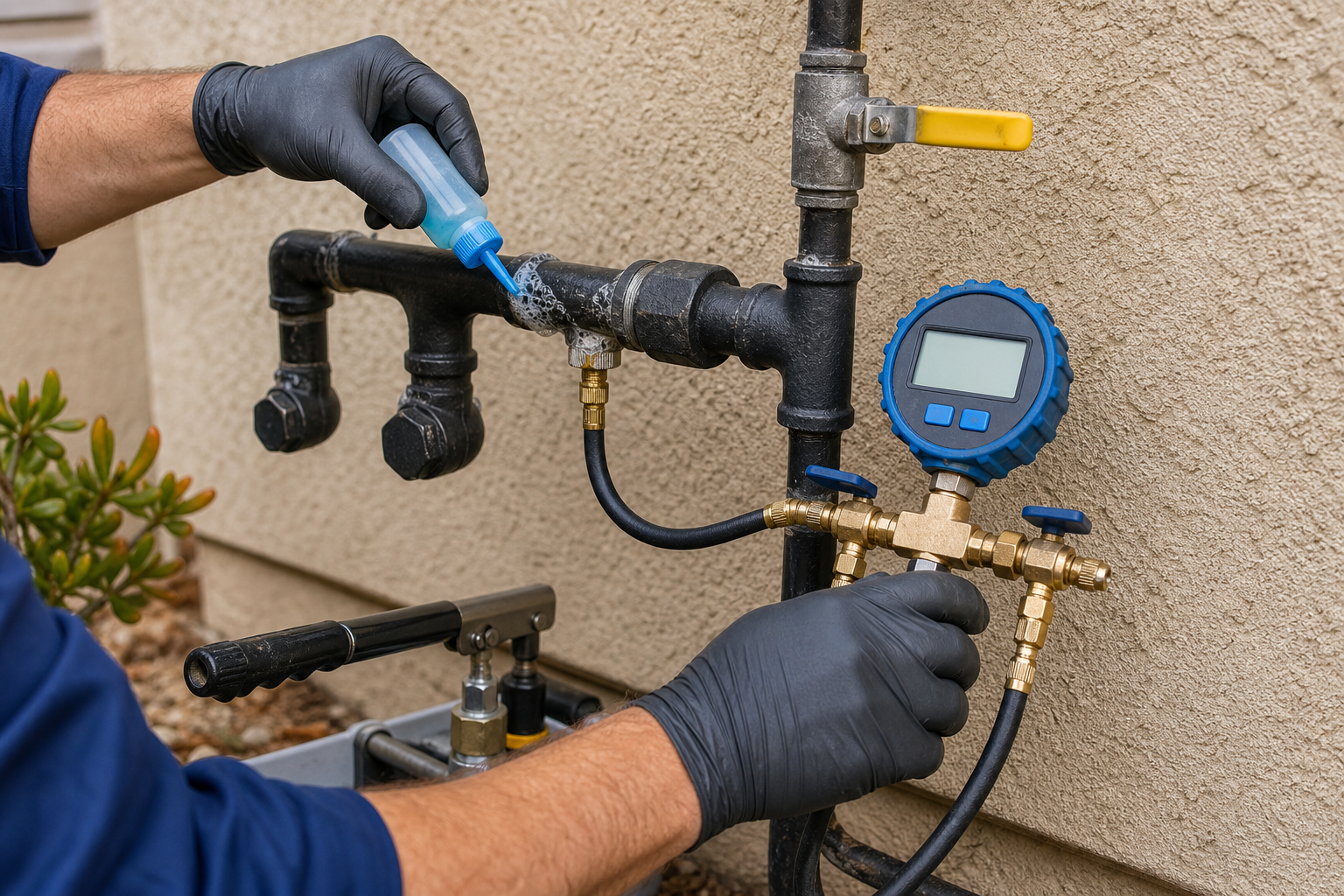
A professional gas-line pressure test can show whether an isolated piping system holds pressure or is losing it somewhere along the tested section. A stable result supports the conclusion that the isolated piping held under the test conditions. A confirmed pressure drop indicates that the system needs further investigation before it is returned to service.
The test does not automatically identify the exact leaking joint, appliance connector, valve, or buried section. It provides system-level evidence that helps a qualified plumber decide where to investigate next and how broad the repair may need to be.
Treat a Gas Odor as an Immediate Safety Issue
Do not wait for a scheduled pressure test if you smell gas, hear hissing near gas equipment, or have another reason to suspect an active leak. Leave the area, keep flames and smoking materials away, and do not operate lights, switches, appliances, garage doors, or phones inside the affected building.
From a safe location, contact the gas utility or emergency services and follow their instructions. Do not return until the appropriate authority says it is safe. A plumbing appointment is not a substitute for the utility or emergency response to a suspected active gas release. For urgent plumbing problems unrelated to a suspected gas release, review emergency plumbing guidance.
Why the Gas Piping Must Be Isolated for Testing
A professional pressure test is performed on a controlled, isolated section of piping. Appliances, regulators, meters, valves, and other components may have different pressure limits or testing requirements, so the plumber must determine what belongs inside and outside the test boundary.
The procedure depends on the piping arrangement, appliance connections, property conditions, and requirements from the local authority or gas utility. The plumber uses approved test equipment and a suitable test medium; fuel gas is not released into the building to perform the test.
This is not a homeowner troubleshooting task. Incorrect pressure, an improper connection, or failure to isolate a component can damage equipment and create a serious hazard.
What a Stable Pressure Reading Means
After the isolated piping is brought to the required test condition, the professional watches the instrument for the specified period. A reading that remains stable supports the conclusion that the tested section did not show measurable loss under those conditions.
That result applies to the boundaries and conditions of the test. It does not prove that an appliance operates correctly, that combustion or venting is safe, or that every component outside the isolated piping is leak-free. Separate appliance, connector, regulator, and operating checks may still be required.
Temperature changes, equipment accuracy, and the volume of the tested piping can affect how readings are interpreted. A qualified plumber accounts for those factors instead of treating a small instrument movement as an automatic repair diagnosis.
What Falling Pressure Can Reveal
If pressure falls beyond what the test conditions allow, the tested section is not holding. That finding confirms the need to locate the loss before the system can be approved for use.
The rate of loss may help the plumber judge how to proceed, but it does not identify the precise defect on its own. A leaking threaded joint, damaged pipe, failed valve, loose appliance connection, concealed branch, or underground section can produce the same basic test outcome.
The plumber may visually inspect accessible piping, use approved leak-detection solution at appropriate joints, review recent work, and divide the system into smaller test sections when the layout permits. Each additional finding narrows the area that requires repair.
How Section Testing Can Reduce Unnecessary Work
A home may have several gas branches serving different appliances or parts of the property. When the full isolated system does not hold, controlled section testing can help determine which branch contains the loss.
For example, one branch may hold while another continues to drop. That difference can focus the investigation on a smaller group of fittings or a particular pipe route instead of assuming the entire system must be replaced.
Access still matters. A confirmed leak inside a wall, beneath a slab, underground, or near a finished surface may require additional locating and a carefully planned opening. The safest repair is based on the actual defect, the surrounding pipe condition, and code-compliant access—not only on the first gauge reading.
How the Findings Shape the Repair Recommendation
Once the likely leak area is identified, the plumber evaluates the pipe material, corrosion, joint condition, prior repairs, route, and access. A single accessible fitting may support a focused repair. Multiple failures, widespread corrosion, damaged pipe, or repeated leaks along the same run may justify discussing a larger replacement.
Ask which test result confirmed the loss, which section was isolated, how the likely location was narrowed, and why the proposed repair scope fits the evidence. If surfaces must be opened, ask what access is included and who is responsible for restoration afterward.
Permit, inspection, and utility requirements can vary with the work. The plumber should explain which approvals apply before the system is returned to service.
Why Retesting Matters After Gas-Line Repair
Repairing the suspected fitting or pipe is not the final proof that the system holds. The repaired section should be retested under the applicable professional requirements. Accessible repaired joints may also receive additional leak checks.
A passing post-repair test supports the conclusion that the isolated piping held after the work. Appliance reconnection, startup, combustion, and venting checks remain separate steps when they apply. The gas supply should be restored only through the required utility, inspection, and qualified-service process.
Arrange Professional Gas-Line Testing in Los Angeles
If a utility shutoff, failed inspection, renovation, or suspected gas-line problem requires professional testing, leave the piping, valves, and appliances undisturbed.
Call MAP Plumbing and Rooter at (323) 900-5201 to discuss gas-line diagnosis and repair in Los Angeles. If you currently smell gas or suspect an active release, leave first and contact the gas utility or emergency services from a safe location.