
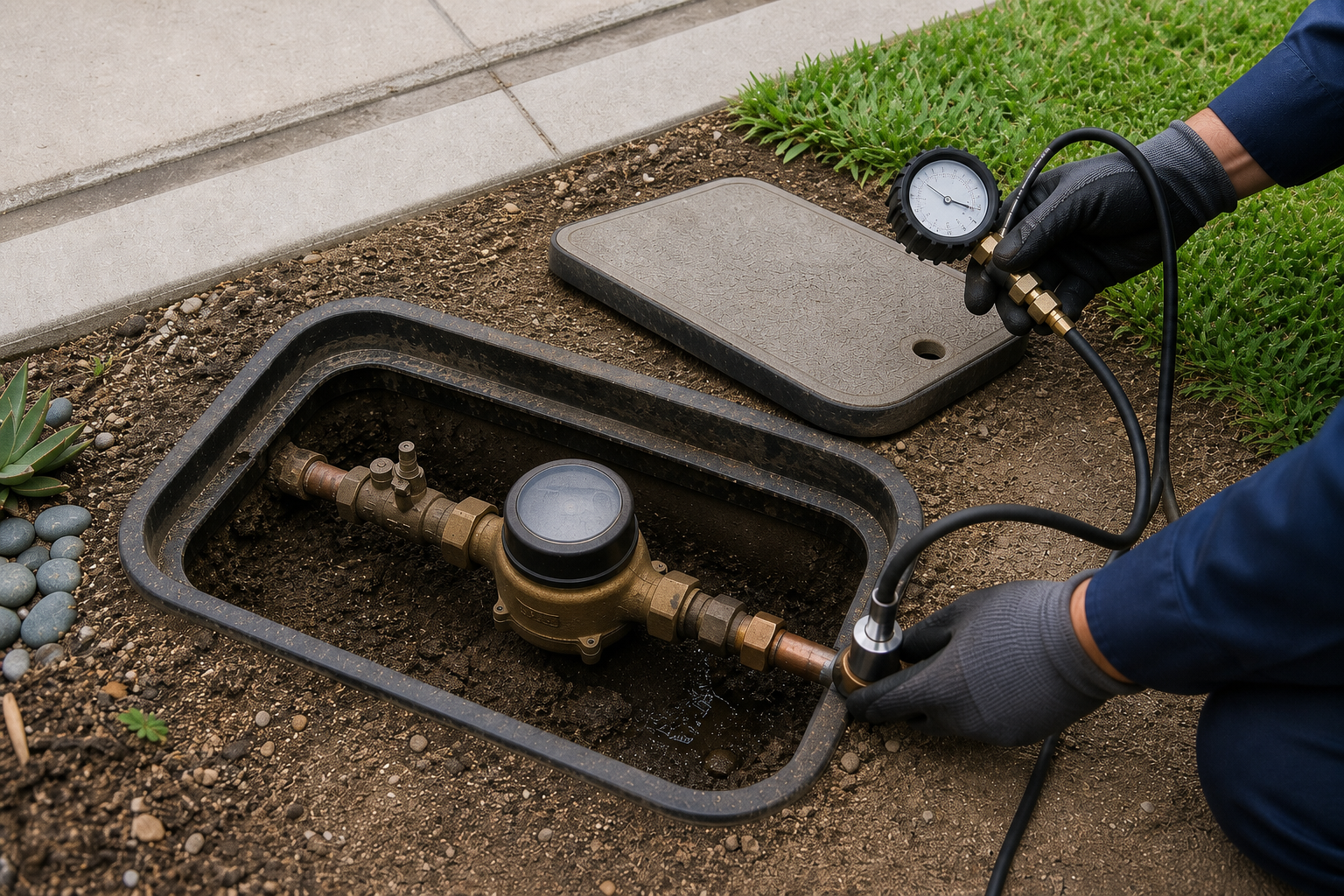
A plumber does not decide which side of a water meter is leaking from pooled water alone. The diagnosis usually combines an all-fixtures-off meter observation, controlled isolation at the home’s accessible main shutoff, inspection of both meter connections, and non-invasive listening or pressure checks. Those findings help separate an upstream utility-side concern, a meter-assembly leak, a buried private supply-line leak, and a leak farther inside the property.
Do not open sealed meter hardware or operate a utility curb stop yourself. If water is rapidly filling the box, washing away soil, entering the home, or causing a sudden loss of service, keep clear of the area and contact the water utility and a plumber. The legal maintenance boundary is not identical in every service area, so the location of the leak should be confirmed before anyone assigns repair responsibility.
What “Which Side of the Meter” Actually Means
Water normally reaches a property through a utility main, a service connection, the meter assembly, and then private piping that carries water toward the building. The meter has an inlet side facing the source of supply and an outlet side feeding the property. A separate customer-accessible main shutoff may be near the meter, at the building, in a garage, or somewhere along that outlet piping.
Those physical sections matter because they answer different questions:
- Is water escaping before it passes through the meter?
- Is the meter body, coupling, or nearby shutoff hardware leaking?
- Is the buried pipe between the meter and the home’s main valve leaking?
- Is water being lost through a fixture, appliance, irrigation branch, or concealed pipe after the house valve?
The meter is a useful reference point, but it is not safe to assume that it is always the legal dividing line between utility and property-owner responsibility. Utilities define their own service boundaries, and the arrangement can differ between properties. A plumber can identify the likely physical location and document what is observed; the applicable utility determines how its equipment and service rules apply.
A Wet Meter Box Does Not Prove Which Pipe Failed
Water naturally collects at low points. A meter box can receive rain, irrigation runoff, groundwater, landscape drainage, condensation, or water traveling through soil from a leak several feet away. Moisture at the right-hand coupling does not necessarily mean that coupling is the source. Water can follow the pipe, the bottom of the box, or disturbed soil before it becomes visible.
The timing provides useful context. A box that becomes wet only after sprinklers run points in a different direction than one that fills while irrigation is off. Continuous clear water with active meter movement deserves a different test than stagnant water after a storm. Rust staining, mineral deposits, fresh soil erosion, hissing, or a concentrated wet path may help focus the inspection, but none of these signs proves ownership or the exact failed fitting.
A plumber first looks for a repeatable pattern. Drying or pumping out the box may be necessary before the meter body and both connections can be seen. If the box refills, the direction and rate of returning water can provide evidence without disconnecting any equipment.
The First Check Is Whether Water Is Passing Through the Meter
Before interpreting the meter, every known water use should be stopped. Faucets, toilets, water-using appliances, irrigation, pool equipment, humidifiers, automatic fillers, and treatment equipment can create legitimate flow. A toilet that refills intermittently or an irrigation controller that starts unexpectedly can make a hidden-leak test look positive.
With those uses controlled, the plumber observes the meter’s low-flow or usage indicator. Continued movement means water is passing through the meter. That supports a downstream demand or leak, but it does not reveal the exact pipe by itself.
No visible movement is also not a complete clearance. A leak may be intermittent, smaller than the indicator can show during a short observation, or located upstream of the measured flow. The meter may also be difficult to read because of water, debris, glare, or damage. The observation must be combined with the piping layout and additional tests.
For broader preventive context, MAP Plumbing and Rooter’s plumbing inspection checklist for Los Angeles homes explains why meter, valve, pressure, fixture, and visible-pipe checks work best as a system rather than as isolated clues.
The House-Main Isolation Test Narrows the Downstream Side
If unexplained flow continues, a plumber may isolate the property using the customer’s accessible main shutoff. This is not the sealed utility curb stop or meter hardware. The valve must be identified correctly and operated without forcing a seized, corroded, or fragile component.
The meter is then observed again. Two broad patterns can follow.
The Meter Stops After the House Valve Closes
If movement stops after a functioning house valve fully isolates the building, the unexplained flow is likely beyond that valve. The next checks may include toilets, fixtures, appliances, irrigation branches, water-treatment equipment, and concealed interior or exterior piping.
This result does not name the exact fixture or pipe. It only narrows the search to plumbing that the valve successfully isolated. A branch may still need its own controlled test.
The Meter Keeps Moving After the House Valve Closes
If movement continues, the buried outlet pipe between the meter and the house valve becomes a stronger suspect. A valve that does not close completely can produce the same pattern, so the plumber must confirm that the valve actually isolated the property before concluding that the service line leaks.
The result also does not prove that the street side is sound. It shows that metered water is still moving despite the attempted isolation. The plumber may need to evaluate the valve, trace the private service route, and ask the utility to inspect sealed or upstream equipment.
How the Inlet Side and Meter Assembly Are Evaluated
An upstream leak may not register as water passing through the meter because the loss can occur before the measuring chamber. A leaking inlet coupling, meter body, utility shutoff, or nearby service connection may instead show itself through visible seepage, sound, pressure behavior, or water returning to the box when downstream demand is stopped.
The plumber can inspect accessible surfaces and listen on each side without loosening sealed components. If the evidence points to utility equipment or the upstream connection, the water provider may need to perform its own inspection. The utility can confirm which parts it maintains and whether its crew must isolate the service.
Do not assume that water on the inlet side automatically belongs to the utility or that water on the outlet side automatically belongs to the homeowner. The physical leak location and the maintenance boundary are two separate findings.
Non-Invasive Tests Help Confirm the Suspected Section
Meter and valve observations narrow the search. Additional tests help confirm whether the suspected pipe actually behaves like a leaking section.
A plumber may use:
- Acoustic listening equipment to compare sound at the meter, valves, accessible pipe, and fittings.
- Pressure observations to see whether an isolated section holds or loses pressure under controlled conditions.
- Flow measurements to compare unexplained usage before and after individual branches are isolated.
- Moisture tracing to follow fresh water through soil, walls, flooring, or the meter enclosure.
- Pipe locating equipment to establish the route between the meter and the building before any digging is considered.
- Targeted exposure only after the evidence points to a limited area.
Not every leak produces a clear sound. Soil type, pipe material, depth, traffic, irrigation, and the size of the opening can affect what the equipment detects. A quiet listening result should not overrule active meter movement, pressure loss, or visible soil erosion.
The goal is to reduce guesswork. Broad excavation based only on a wet box can miss the source and damage landscaping or utility lines. A water line repair assessment in Los Angeles should identify the affected section before a repair method is chosen.
Pressure Loss Can Add Context but Does Not Locate the Leak Alone
Low pressure throughout the home may accompany a significant service-line leak, a partially closed valve, a failing regulator, restricted piping, or a utility-supply issue. Normal pressure does not rule out a slow underground leak.
Pressure should therefore support the meter and isolation findings, not replace them. If the main concern is weak, high, or fluctuating flow rather than water around the meter, the water-pressure diagnostic for Los Angeles homes covers the separate checks for regulators, valves, fixture restrictions, pipe condition, and municipal supply.
A plumber should avoid recommending service-line replacement from a pressure symptom alone. The affected section and failure mechanism still need confirmation.
When the Water Utility and Plumber May Both Be Needed
Coordination is common when the suspected source is close to the meter. A plumber may confirm that unexplained metered flow continues with the building isolated, while the utility checks its sealed shutoff, meter body, inlet connection, or upstream service. One party’s observation can help the other avoid repeating broad tests.
When contacting the utility, provide specific facts:
- Whether the meter box contains standing or flowing water.
- Whether irrigation and all known water uses were off.
- Whether the meter showed movement.
- Whether a plumber operated the customer’s house valve and how the meter responded.
- Whether pressure or service changed suddenly.
- Whether soil is eroding or water is reaching a sidewalk, street, foundation, or electrical equipment.
Ask the utility to confirm its maintenance boundary for the property. Do not rely on a neighbor’s arrangement or a general rule found online.
What a Homeowner Should Not Do at the Meter Box
The meter enclosure may contain utility-owned equipment, a fragile older valve, insects, sharp debris, contaminated runoff, or electrical bonding components. Keep the inspection visual unless you are following direct instructions from the utility.
Avoid these actions:
- Do not break a seal or remove the meter.
- Do not operate a utility curb stop with pliers, a wrench, or an improvised key.
- Do not loosen a coupling to see which side releases water.
- Do not attach a pressure gauge to meter hardware.
- Do not enter a flooded box with a hand or tool when the contents cannot be seen.
- Do not dig until underground utilities and the water-line route are identified.
- Do not pour dye, drain cleaner, sealant, or other material into the box.
If you know the location of a separate customer-owned house shutoff and it operates normally, it may help limit water entering the building during an active leak. Do not force it. A valve that begins leaking or will not move needs professional handling.
Signs the Leak Needs an Urgent Response
Arrange prompt help when water is actively flowing, the meter spins rapidly with known uses off, pressure drops suddenly, or the ground begins to wash out. Keep people away from softened soil, a sinking walkway, or water near electrical service.
Use an emergency plumber in Panorama City and Los Angeles when private plumbing may be releasing enough water to damage the building or property. Contact the water utility as well when the meter, sealed shutoff, street-side connection, or public service appears involved.
Water entering a wall, slab, crawl space, garage, or living area requires damage-limiting action even if the meter box looks dry. The visible water may be far from the underground source.
What to Expect From a Focused Water-Line Inspection
The plumber should begin by documenting the meter box, piping direction, accessible valves, meter behavior, pressure pattern, and current water use. A controlled isolation sequence follows. If the evidence narrows the concern to the buried outlet line, the route can be located and tested before a repair area is selected.
The final recommendation depends on what is found. A loose accessible private fitting, a failed valve, a localized pipe opening, and a deteriorated service line require different responses. The inspection should explain which section is affected, what evidence supports that conclusion, whether the utility must participate, and how the repair can be verified afterward.
After work is complete, the system should be returned to normal service and checked again with known water uses off. The repaired area, meter behavior, pressure, and disturbed ground should be reviewed before the job is considered finished.
Get Help Locating a Suspected Water-Meter-Area Leak
Water around a meter box is a reason to investigate, not a reliable diagnosis by itself. The safest path is to control known water use, leave sealed utility equipment alone, and let the meter, house valve, pipe route, and non-invasive tests narrow the source.
MAP Plumbing and Rooter can evaluate the private water-line side, document the meter and isolation behavior, and coordinate the next step when utility equipment may be involved. Contact MAP Plumbing and Rooter for a focused water-line inspection in Los Angeles when the meter moves with everything off, water keeps returning to the box, or an underground supply leak is suspected.
Frequently Asked Questions
Does water in the meter box mean the utility side is leaking?
No. Rain, irrigation, drainage, groundwater, a meter connection, or a leak on either pipe direction can wet the box. The return pattern, meter movement, isolation results, and physical inspection are needed before the source can be assigned.
If the meter moves with every faucet off, is the service line leaking?
It means water is passing through the meter without a known use. A toilet, appliance, irrigation branch, interior pipe, or buried service segment could be responsible. Closing and verifying the customer’s house-main valve helps narrow the downstream area.
What if the meter keeps moving after the house valve is closed?
The pipe between the meter and that valve becomes a stronger suspect, but the valve may not have sealed completely. A plumber should verify the isolation and confirm the line route before recommending excavation or repair.
Can a plumber repair the street side of the meter?
That depends on the physical location, utility equipment, and the provider’s maintenance boundary. A plumber can document the suspected source, but the water utility should confirm who is authorized and responsible for work on its side or sealed components.
Should I turn the valve inside the meter box?
Do not operate a utility curb stop, sealed valve, or meter hardware unless the utility directly authorizes and instructs you to do so. Use a known customer-accessible house shutoff only if it operates normally and can be reached safely.